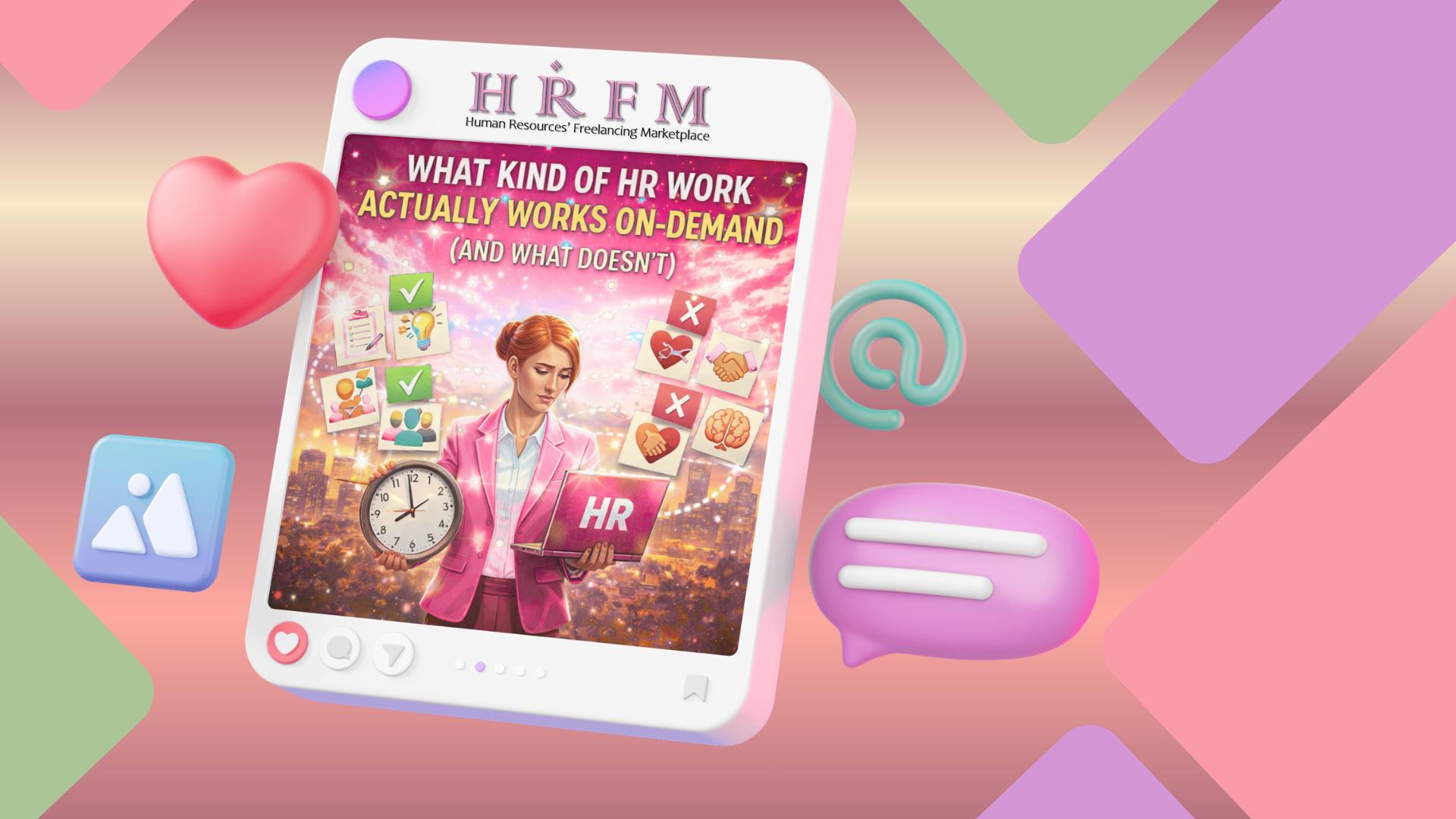
A practical guide to deciding what HR work should be done on-demand, in-house, or through a hybrid model. This article breaks down high-impact use cases where on-demand HR delivers speed, expertise, and efficiency—while warning against critical areas that require internal ownership. Ideal for leaders looking to reduce risk, optimize resources, and build a smarter, more agile HR operating model.
One of the biggest hidden reasons HR initiatives fail is misuse of the delivery model.
Organizations often ask the wrong question:
“Can this be outsourced?”
The better question is:
“Should this be done on-demand, internally, or in a hybrid way?”
Because not all HR work behaves the same.
Some tasks are perfect for on-demand execution.
Some are dangerous to externalize.
And some require a blended approach.
This article draws that line clearly.
The First-Principles Rule
From everything we have seen, one simple rule holds:
On-demand works best when the work is:
Outcome-based
Time-bound
Specialized
Or backlog-driven
And it struggles when the work is:
Identity-defining
Politically sensitive
Or requires continuous internal authority
Let’s make this practical.
Category 1: Perfect for On-Demand
These are the highest ROI, lowest risk use cases.
1. Hiring for Specialized or Unusual Roles
Examples:
ERP implementation specialists
Data privacy officers
Comp & benefits architects
Factory HR setup
New country entry hiring
Why it works:
Internal teams rarely do these often
Learning cost is high
Mistakes are expensive
Outcome is clearly measurable
On-demand converts rare, high-risk work into proven execution.
2. Policy, Process, and Structure Design
Examples:
Performance management redesign
Grading and leveling systems
SOP creation
HR manuals
Compliance frameworks
Why it works:
These are projects, not permanent jobs
Internal teams are too close to existing habits
External benchmarks matter
On-demand brings pattern recognition and speed.
3. Audits, Diagnostics, and Reviews
Examples:
HR audit
Compensation benchmarking
Compliance checks
Culture or engagement diagnosis
Why it works:
You want independence
You want objectivity
You want credibility
This is almost always better done by outsiders.
4. Backlog Clearance and Capacity Overload
Examples:
Mass recruitment
JD standardization
Data cleanup in HR systems
Documentation and file structuring
Why it works:
Temporary volume spikes
Not worth hiring full-time for
Speed matters more than long-term ownership
On-demand turns bottlenecks into throughput.
Category 2: Works Best in a Hybrid Model
These need internal ownership + external muscle.
1. Talent Acquisition as a Function
External:
Sourcing
Screening
Market mapping
Internal:
Final decision
Culture fit
Stakeholder management
You should never fully outsource your hiring brain.
2. Learning & Development
External:
Content
Facilitation
Frameworks
Internal:
Reinforcement
Culture integration
Behavior change
Training can be outsourced. Learning cannot.
3. Performance & Culture Programs
External:
Design
Tools
Diagnostics
Internal:
Daily application
Leadership behavior
Consequence management
Culture is built inside. But it can be designed and accelerated from outside.
Category 3: Usually a Bad Idea to Fully Externalize
These are core control systems.
1. Employee Relations & Disciplinary Authority
Why:
Requires trust
Requires legitimacy
Requires daily presence
Outsiders cannot carry internal authority.
2. Final Compensation Decisions
Why:
Purely strategic
Purely political
Direct power signal inside the company
You can take advice. You cannot outsource ownership.
3. Leadership & Succession Decisions
Why:
Identity-defining
Power-structuring
Long-term consequence
This is the CEO’s and Board’s job. Always.
The Real Strategic Mistake Companies Make
They either:
Try to do everything internally
Or:Try to outsource everything impulsively
Both are wrong.
The correct model is:
Internal team owns the system.
On-demand experts accelerate specific outcomes.
How This Makes HRFM Different
HRFM is not built to:
Replace HR teams
Or hollow out organizations
It is built to:
Extend HR teams with precise, high-impact capability exactly when needed.
Think of it as:
A force multiplier
Not a substitute
A Simple Decision Filter You Can Use
Before externalizing any HR work, ask:
Is this time-bound or ongoing?
Is this specialized or routine?
Is the cost of mistakes high?
Does this require internal authority to succeed?
If:
Yes to 1, 2, or 3 → Strong on-demand candidate
Yes to 4 → Must remain internal (or hybrid)
Final Thought
The future of HR is not “in-house vs outsourced.”
It is:
Architects inside.
Special forces on-demand.
The organizations that master this model will:
Move faster
Make fewer mistakes
And waste far less management energy.